Publications
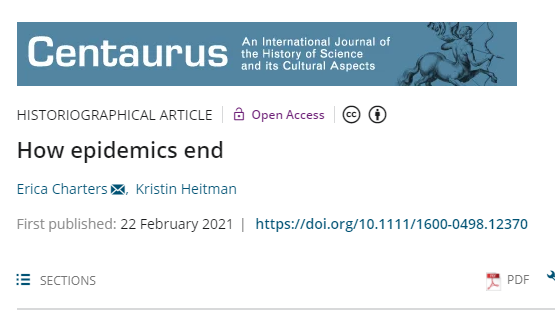
As COVID‐19 drags on and new vaccines promise widespread immunity, the world's attention has turned to predicting how the present pandemic will end. How do societies know when an epidemic is over and normal life can resume? What criteria and markers indicate such an end? Who has the insight, authority, and credibility to decipher these signs? This article examines the ways in which scholars have identified and described the end stages of previous epidemics, pointing out that significantly less attention has been paid to these periods than to origins and climaxes. A multidisciplinary analysis of how epidemics end suggests that epidemics should therefore be framed not as linear narratives—from outbreak to intervention to termination—but within cycles of disease and with a multiplicity of endings.
Charters, E, Heitman, K. How epidemics end. Centaurus. 2021; 63: 210– 224. https://doi.org/10.1111/1600-0498.12370
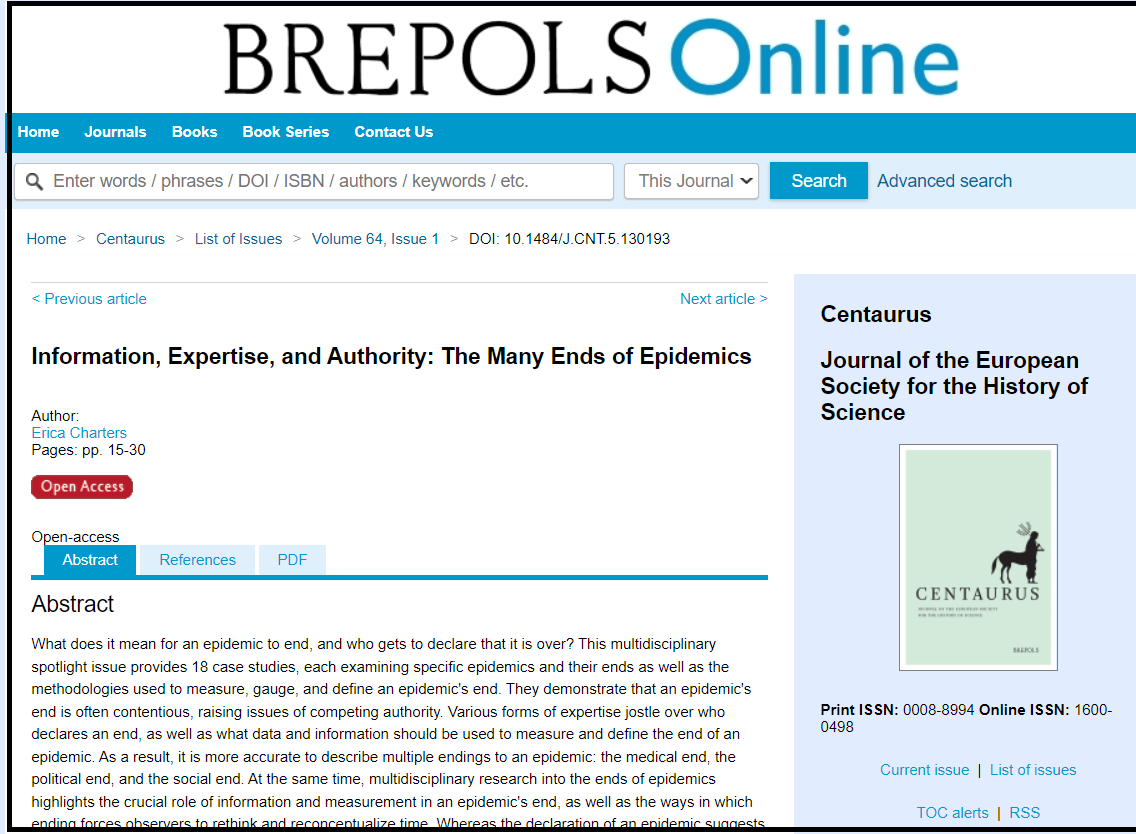
What does it mean for an epidemic to end, and who gets to declare that it is over? This multidisciplinary spotlight issue provides 18 case studies, each examining specific epidemics and their ends as well as the methodologies used to measure, gauge, and define an epidemic's end. They demonstrate that an epidemic's end is often contentious, raising issues of competing authority. Various forms of expertise jostle over who declares an end, as well as what data and information should be used to measure and define the end of an epidemic. As a result, it is more accurate to describe multiple endings to an epidemic: the medical end, the political end, and the social end. At the same time, multidisciplinary research into the ends of epidemics highlights the crucial role of information and measurement in an epidemic's end, as well as the ways in which ending forces observers to rethink and reconceptualize time.
Centaurus. Journal of the European Society for the History of Science, Volume 64 (2022), Issue 1. Spotlight Issue: How Epidemics End, edited by Erica Charters. 311 p., 13 colour ill., 178 x 254 mm, 2022
ISBN: 978-2-503-59852-9 Print ISSN: 0008-8994 Online ISSN: 1600-0498